When a Child’s Kite Becomes a Military Threat
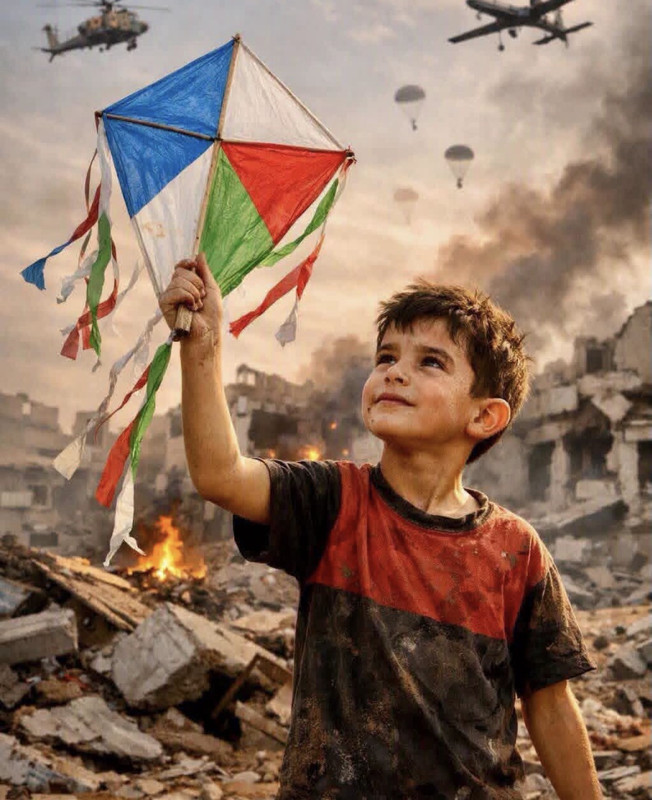
A child in Gaza flies a kite.
There is nothing unusual about that sentence.
Children everywhere fly kites. They run with the wind, laugh when the string pulls against their hands, chase the kite when it dips, and watch it rise into the sky. For a few minutes, they are simply children.
But in Gaza, even this can become dangerous.
Israeli Defense Minister Israel Katz has ordered the military to respond forcefully to kites, saying every launch would be treated as an act of war. Israeli leaders have also threatened intensified strikes and the evacuation of areas from which such launches take place.
The Israeli military said no suspicious items were found on the kites and that they posed no danger to the public. Yet Israel’s defense minister said a kite would be treated like a drone, with or without explosives.
Let that sink in.
A child picks up a kite.
They run.
They watch it rise.
And suddenly, the neighborhood where they live may be threatened with strikes and displacement.
What kind of world turns a kite into a military threat?
This is not simply a story about a kite. It is a story about what happens when war reaches so deeply into childhood that even the most ordinary forms of play become part of its vocabulary.
For children elsewhere, a kite might mean summer. A field. A beach. A park. A parent holding a spool of string while a child runs ahead.
For a child in Gaza, there may be no safe playground waiting at the end of the street.
Much of what once gave children a place to play has been destroyed. They have lost their homes, schools, playgrounds, and places of recreation. In Gaza, children are left with little more than temporary shelters and whatever small things they can turn into a game.
So they improvise.
A plastic bag.
A few sticks.
A piece of string.
The wind.
A kite.
These are not luxuries.
They are fragments of childhood.
And when even those fragments are treated as threats, something much larger is being taken away.
The right to play.
The right to forget the war for a few minutes.
The right to look at the sky without calculating what might come from it.
Imagine trying to explain this to a child.
“Don’t fly it.”
“Put it down.”
“Be careful.”
Not because the toy itself is dangerous to the child, but because playing with it could put the place where they live at risk.
Imagine growing up knowing that something as harmless as a kite could become a reason for your neighborhood to be threatened with strikes and displacement.
What does that teach a child about the world?
That safety is temporary.
That home can disappear.
That the sky is not simply the sky.
That even play has consequences.
Children are supposed to learn that the sky is beautiful.
They are supposed to look upward and see clouds, birds, stars and kites.
They are not supposed to look upward and wonder what is coming.
They are not supposed to learn the sounds of drones and aircraft before they have learned the ordinary sounds of childhood.
They are not supposed to understand displacement before they understand what it means to have a home.
And they should never have to learn that a toy can be interpreted as an act of war.
This is what makes the story bigger than the kite.
It is about the shrinking space in which a Palestinian child is allowed to be a child.
The world often asks what kind of adults children growing up in war will become.
Will they be angry?
Will they distrust?
Will they carry their childhood wounds into adulthood?
Those questions matter.
But perhaps we should ask another question first:
What kind of childhood did they have?
What did they play with?
Where did they run?
Where were they allowed to feel safe?
What did they see when they looked at the sky?
Did they ever have a place where they could simply be children?
Because when a child grows up learning that even a kite can become a military threat, they are growing up in anything but an ordinary world.
And one day, when the world looks at the adults these children become and asks why they carry so much anger, fear or pain, we should remember the children they were first.
Remember what they lost.
Remember what they were taught to fear.
Remember the small pieces of childhood that disappeared before they were old enough to understand why.
A kite should be a kite.
A game should be a game.
A summer afternoon should not require a military assessment.
And a child should never have to wonder whether the thing they are holding in their hands could put their family, their neighbors, or their home in danger.
When a child’s kite becomes a military threat, the real question is no longer what the kite can do.
The question is:
What has happened to the world around that child that makes a kite look like a weapon?
The answer is not in the kite.
It is in the childhood being taken away.
Even the sky is no longer simply the sky.
Even the kite is no longer simply a kite.
And that is what the world should be paying attention to.
Aseel | Writer from Gaza